
Antonio Negri was an Italian political philosopher who in his time courted controversy, and was even jailed for links with Communist organisations. Leonardo Caffo talked with him about the future of the Left.
This is a fragment of an interview with the late Toni Negri I conducted in Paris several years ago during my doctoral research. It was originally commissioned by the newspaper Corriere della Sera, but was ultimately rejected by my editor at the time with the statement, “Toni Negri is someone we probably cannot publish.”
Professor Negri, I would like to start with a provocation. In various forums and even in classes we’re dissecting the neurosis of the contemporary Left: its retreat from economic conflict, its obsession with moral purity, and its submission to the digital. You yourself, along with Michael Hardt, in the book Empire (2000) diagnosed the end of classical state sovereignty. But today the Empire seems less like the diffuse network of power you described, and more like a surveillance technocracy governed by Big Tech and high finance. Is the Left now serving as the public relations agent for this very Empire?
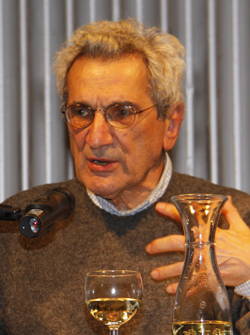
Portrait photo Rosa Luxemburg-Stiftung 2009 Creative Commons 2
That is an accurate, albeit tragic, formulation. You see, the core concept of Empire was not precisely the end of sovereignty, but rather its transformation into a total, center-less, but reticular [network-like] apparatus of dominion. Moreover, what you generically called ‘digital’ is updated biopower [human resources]. It is the capacity to organize and control productive and emotional life. The failure of the Left in the post-2001 era lies in having misunderstood this transition. Instead of grasping the Empire in its abstraction and globality – in the flow of financial capital, in immaterial production – the Left has clung to the fetish of the nation-state, or worse, retreated into the only sphere the Empire left it: the moral domain of the small self. The modern Left have mistaken the struggle for liberation with the hygiene of language. This is a form of self-castration.
You speak of the Multitude as the revolutionary subject, capable of producing counter-power. But in protests at the G8 in 2001, the Multitude – the last collective on the streets against physical and political capital – was crushed by state violence and subsequently fragmented. In the 1980s, heroin served as a chemical mechanism to disarm revolt, as I have analyzed. Today, the mechanism is the Algorithm, which transforms the body into an avatar and political action into a feed performance. Does the Multitude still exist, or is it now merely an aggregation of isolated and surveilled individuals?
The Multitude is always present, because it is the totality of the productive subjects of biopower. We all produce value through our communication, our relationships, our knowledge – this is immaterial labor. But it’s true, the discipline of the people by the state has become subtler and more total, moving from the truncheon to the network.

